
10th class all subject SA 1 Question Papers (2025-26)
10th class all subject SA 1 Question Papers 2025-26
Score 80+ in SSLC 2026 & Study Plan. Score 80+ in SSLC 2026. The SSLC exams are a major milestone, and for the 2026 batch, the path to success is clearer than ever. The official blueprints are out, and they are your ultimate cheat sheet!
If you’re aiming to score 80+ and above, you’re in the right place. In this guide, we’re going to decode the chapter-wise marks distribution for English, Hindi, Kannada, Maths, Science, and Social Science. We’ll uncover the secrets hidden in these blueprints and build a foolproof study plan to help you conquer the exams with confidence.
Let’s turn those blueprints into a winning strategy!
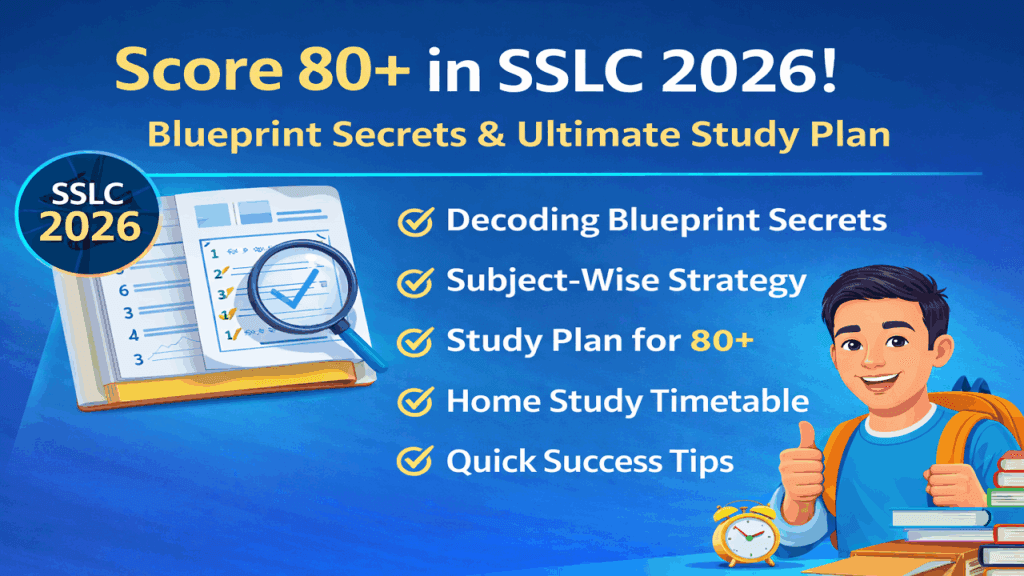
Table of Contents
Score 80+ in SSLC 2026 & Study Plan
Part 1: Decoding the Blueprint Secrets
First, let’s understand the language of the blueprints. The examination pattern for 2025-26 is designed to test your understanding through a mix of question types. Here’s a quick legend:
- 1 Mark Questions: (MCQs, Very Short Answers) – The foundation of your score.
- 2 Mark Questions: (Short Answers) – Often have internal choices.
- 3, 4, & 5 Mark Questions: (Long Answers, Essays) – The game-changers. These chapters require deep understanding.
A common theme across all subjects is the generous provision of internal choices (like answering 5 out of 7 questions), which significantly boosts your chances of scoring well if you have prepared multiple topics. Score 80+ in SSLC 2026 & Study Plan.
Now, let’s dive subject-by-subject.
Download English Grammar Book for SSLC
The Ultimate Study Plan to Score 80+
Now that you know the secrets, here’s a 6-month plan to execute your preparation:
Phase 1: Foundation Building (Now – December 2025)
- Goal: Cover 100% of the syllabus once.
- Action: Focus on all chapters from the blueprints. Pay special attention to the high-weightage (4 & 5 mark) chapters identified above.
- Tip: Make short notes for Social Science and Science. Solve all back-of-the-chapter questions for Maths.
Phase 2: Practice & Perfection (January – February 2026)
- Goal: Master writing answers and time management.
- Action:
- Writing Practice: Practice writing 3 and 5-mark answers within a time limit. Focus on presentation (underline keywords, draw diagrams where possible).
- Grammar & Composition: Daily practice of one letter/essay (Languages), editing exercises (English), and translation (Hindi).
- Maths: Solve problems from previous years’ papers, focusing on 4-mark questions.
Phase 3: Revision & Mock Tests (February – March 2026)
- Goal: Final revision and exam simulation.
- Action:
- Take Full-Length Mock Tests: Use the blueprint to create your own question paper or use reliable guides. Simulate exam conditions.
- Revise Notes: Go through your short notes for Science and Social Science.
- Focus on “Internal Choices”: Plan your “choice strategy.” For example, in the Science exam, decide beforehand which optional questions you will attempt based on your strengths. Score 80+ in SSLC 2026 & Study Plan.
Download SSLC English Scoring notes
Final Words of Wisdom
The blueprints for 2025-26 are your roadmap to success. They are not just a list of chapters; they are a guide on how to distribute your precious study time.
- Don’t ignore the 1-mark questions. They are the low-hanging fruit. Make sure you secure them.
- Practice, Practice, Practice: Especially for languages and math, there is no substitute for writing with a pen and paper.
- Stay Positive: An 80+ score is absolutely achievable with smart work and consistent effort.
Good luck with your SSLC 2026 preparation! You’ve got this!
Your SSLC 2026 Home Study Timetable
(Morning & Evening Slots Only)
Total Study Time: ~4 to 5 hours daily (excluding homework)
Focus: Reinforcement of school topics + Self-study of high-scoring chapters. Score 80+ in SSLC 2026 & Study Plan.
Morning Session (Before School)
This session is crucial because your mind is fresh. Use it for subjects that require memory or language practice.
School Time (9:00 AM – 5:00 PM)
- The Golden Rule: Pay 100% attention in class. If your teacher explains a chapter from the blueprint (like The Discovery in English or Quadratic Equations in Maths), try to understand it right there. This reduces your evening study load by half.
Evening Session (After School)
This is your main study block. Don’t start immediately after coming home. Rest first.
Quick Tips for Success:
- Stay Hydrated: Keep a water bottle on your study table.
- Phone Away: Keep your phone in another room during study slots (6:15 PM to 9:40 PM).
- Don’t Cram: This schedule is designed to be sustainable. If you follow this 5-6 days a week, you will cover the entire syllabus twice before the exams.
Good luck! You’ve got the blueprints and the plan—now it’s time to execute