
Prepositions and Types of Prepositions. Confused by prepositions? Our ultimate guide breaks down all 8 types of prepositions with clear examples. Master English grammar and improve your writing skills today!
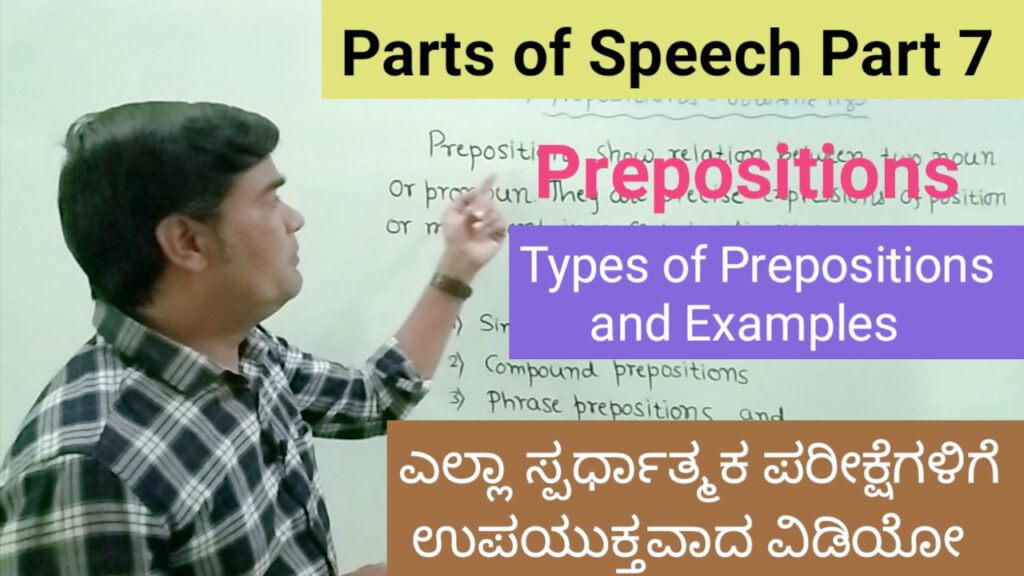
Table of Contents
Prepositions and Types of Prepositions with Examples
Have you ever wondered about the small words that hold our sentences together? Words like in, on, at, for, and with might seem simple, but they are powerhouses of the English language. These are prepositions, and mastering them is key to speaking and writing with clarity and confidence.
If you’ve found this page after watching our YouTube video on the topic, welcome! This article is your comprehensive, written guide to everything you need to know about prepositions. Prepositions and Types of Prepositions.
What is a Preposition? A Simple Definition
In simple terms, a preposition is a word that shows the relationship between a noun (or pronoun) and another word in the sentence. This relationship is often about location, time, direction, or possession.
Think of it as a bridge connecting two ideas.
Example: The cat is on the mat.
Here, the preposition “on” connects “the cat” to “the mat” and shows their spatial relationship.
Prepositions and Types of Prepositions (with Easy Examples)
Let’s dive into the different categories. Understanding these types will make identifying and using prepositions much easier.
1. Prepositions of Time
These tell us when something happens.
- At: For a specific time (at 5 PM, at midnight)
- On: For days and dates (on Monday, on Christmas Day)
- In: For months, years, seasons, and longer periods (in July, in 2023, in the summer)
- Other Common Ones: for, since, during, until
Example: She has a meeting at 9:00 AM on Tuesday.
2. Prepositions of Place
These tell us where something is located.
- At: For a specific point (at the door, at the station)
- On: For a surface (on the wall, on the floor)
- In: For an enclosed space (in the room, in the box)
- Other Common Ones: above, below, between, beside
Example: The keys are in the drawer beside the bed.
3. Prepositions of Direction/Movement
These show the movement from, to, or in a specific direction.
- To: Movement towards a destination (go to school, walk to the park)
- From: Starting point of movement (come from office, a letter from a friend)
- Through: Moving from one end to the other (walk through the tunnel)
- Other Common Ones: into, onto, across, towards
Example: We walked across the bridge and towards the mountains.
4. Prepositions of Manner
These describe how something is done.
- By: Method of doing something (travel by car, send it by email)
- With: Using an instrument or tool (write with a pen, cut with a knife)
- In: A specific way (speak in a loud voice, act in a hurry)
Example: She solved the puzzle with great patience.
5. Prepositions of Agent
These are used to show who or what performed an action, usually with passive voice.
- By: Indicates the doer of the action.
- With: Indicates the tool used for the action.
Example: The book was written by a famous author. (The author did the action).
Example: The door was opened with a key. (The key was the tool).
6. Prepositions of Possession
These show that something belongs to someone or something.
- Of: (the color of the car, the president of the company)
- To: (belongs to me, a friend to all) – less common for possession itself.
Example: The handle of the cup is broken.
7. Phrasal Prepositions
These are groups of words that function together as a single preposition.
- According to: (According to the forecast, it will rain.)
- Because of: (The game was canceled because of the weather.)
- In front of: (Park your car in front of the house.)
- In spite of: (We went out in spite of the cold.)
Example: Because of his hard work, he got a promotion.
8. Simple, Compound, and Double Prepositions
- Simple: Single-word prepositions (in, on, at, for, with).
- Compound: Formed by prefixing a preposition to a noun, adjective, or adverb (inside, outside, within, without).
- Double: Two prepositions used together (from behind, until after).
Common Mistakes to Avoid (AdSense-Friendly Tips for Learners)
- Ending a Sentence with a Preposition: While it’s often okay in informal English (“Who are you going with?”), try to rephrase for formal writing (“With whom are you going?”).
- Confusing In, On, At: Remember the general rule: At a point, On a surface, In an enclosed space.
- Using the Wrong Preposition after an Adjective: This is a classic trap! We say:
- Good at sports (not good in sports)
- Interested in learning (not interested for learning)
- Afraid of spiders (not afraid by spiders)
Let’s Practice!
Test your knowledge! Choose the correct preposition:
- I’ll see you (on / in) Friday.
- She is allergic (of / to) peanuts.
- The movie starts (in / at) 7:30 PM.
- He apologized (for / about) his mistake.
(Answers: 1. on, 2. to, 3. at, 4. for)
Conclusion
Prepositions are the tiny glue that holds the big ideas in our language together. By understanding their types and functions, you can express yourself more precisely and avoid common grammatical errors.
Did you find this guide helpful? We have a whole video series on English grammar on our YouTube Channel. Check it out for more visual learning!