
📚 Nouns and Noun and It’s types in English Grammar (With Easy Examples)
‘Noun and It’s types’In English grammar, there are eight parts of speech, and one of the most essential parts is the noun. Without nouns, it would be nearly impossible to communicate clearly. Whether you’re learning English for school, work, or personal growth, understanding nouns and their types is a great starting point.
Table of Contents
In this post, we will:
- Define what a noun is.
- Discuss the types of nouns.
- Share simple and real-life examples for each noun type.
- Help you strengthen your English grammar foundation.
- Noun and It’s types
🔠 What is a Noun?
A noun is a word used to name a person, place, thing, animal, or idea. Nouns are all around us — everything you see, touch, or think of can be described using a noun. Noun and It’s types.
✅ Examples of nouns:
- Person: teacher, mother, doctor
- Place: India, library, mountain
- Thing: chair, pen, laptop
- Animal: cat, elephant, lion
- Idea: honesty, love, bravery
Without nouns, we couldn’t talk about people, objects, feelings, or anything at all. That’s why nouns are the building blocks of English sentences.
🔍 Why Are Nouns Important? (Noun and It’s types)
Nouns are often the subject or object of a sentence. They help us know who or what we’re talking about. For example:
- Ravi plays cricket. (Here, “Ravi” is the subject – a proper noun)
- She has a beautiful garden. (Here, “garden” is the object – a common noun)
By understanding different types of nouns, we can speak and write more clearly and confidently.
🧩 Types of Nouns
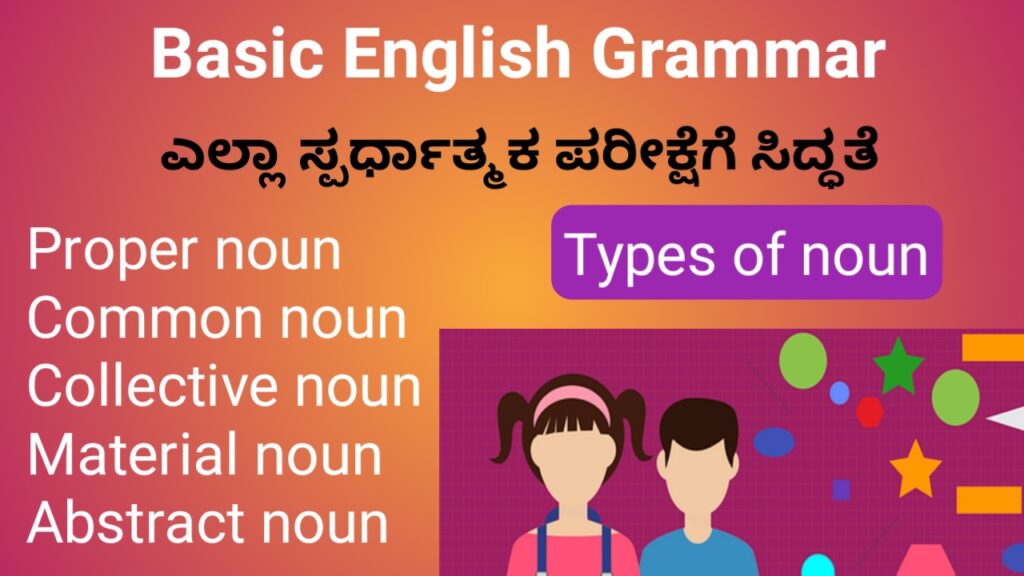
Let’s dive into the five main types of nouns in English:
1. ✨ Proper Noun
A Proper Noun is the specific name of a person, place, day, brand, or thing. It always begins with a capital letter.
🔹 Examples:
- Rahul, Delhi, Amazon, Monday, Taj Mahal
🖊️ Example Sentences:
- Rahul is my best friend.
- I visited the Taj Mahal last year.
- She ordered a dress from Amazon.
Proper nouns are always unique names. You can think of them as labels for one-of-a-kind things.
2. 📦 Common Noun
A Common Noun is the general name for a person, place, or thing. It does not refer to anything specific and usually starts with a lowercase letter unless it begins a sentence.
🔹 Examples:
- city, girl, country, phone, teacher
🖊️ Example Sentences:
- The city was crowded.
- A teacher entered the classroom.
- He lost his phone yesterday.
If a proper noun is like a name, a common noun is like a category.
3. 👥 Collective Noun
A Collective Noun is used to refer to a group of people, animals, or things considered as one unit.
🔹 Examples:
- team, family, bunch, crowd, herd
🖊️ Example Sentences:
- The team is practicing for the tournament.
- A herd of elephants crossed the river.
- The family went on vacation.
Collective nouns help us talk about multiple things as a single group.
4. 🧱 Material Noun
A Material Noun refers to a substance or material that things are made from. These are usually natural or man-made materials.
🔹 Examples:
- water, gold, cotton, iron, plastic
🖊️ Example Sentences:
- The ring is made of gold.
- This bottle is made of plastic.
- We need water to survive.
Material nouns are not counted in numbers. You wouldn’t say “two waters” — you’d say “two bottles of water.”
5. 💭 Abstract Noun
An Abstract Noun names feelings, ideas, emotions, or qualities — things you cannot touch, see, or measure physically.
🔹 Examples:
- honesty, freedom, love, bravery, wisdom
🖊️ Example Sentences:
- Honesty is the best policy.
- She showed great bravery during the fire.
- We all value our freedom.
Abstract nouns describe the intangible side of life — thoughts, values, and emotions.
🧠 How to Identify Nouns in a Sentence?
Try asking these questions:
- Who or what is this sentence about? → Noun is the subject.
- What is being talked about? → Noun is the object.
📝 Examples:
- The dog chased the ball.
- Honesty brings respect.
- My mother works in a hospital.
Each bolded word is a noun playing an important role in the sentence.
📌 Bonus Tip: Countable vs. Uncountable Nouns
While not a type of noun, this is a useful classification:
- Countable Nouns: can be counted
📍 Example: apple, chair, book → two apples, three chairs - Uncountable Nouns: cannot be counted directly
📍 Example: water, milk, rice → some water, a lot of rice
📚 Summary
In this lesson, we learned:
- What a noun is
- Five major types of nouns: Proper, Common, Collective, Material, Abstract
- How to identify nouns in sentences
- Practical examples for better understanding
Learning nouns is the first step in mastering English grammar. As you grow your vocabulary and practice writing, nouns will help you form stronger, clearer sentences.
Watch this video for detail of Noun and It’s types.